
The artificial intelligence industry is often dominated by headlines about new models, chatbot launches, benchmark scores, and increasingly capable AI assistants. But some of the most important developments happen behind the scenes.
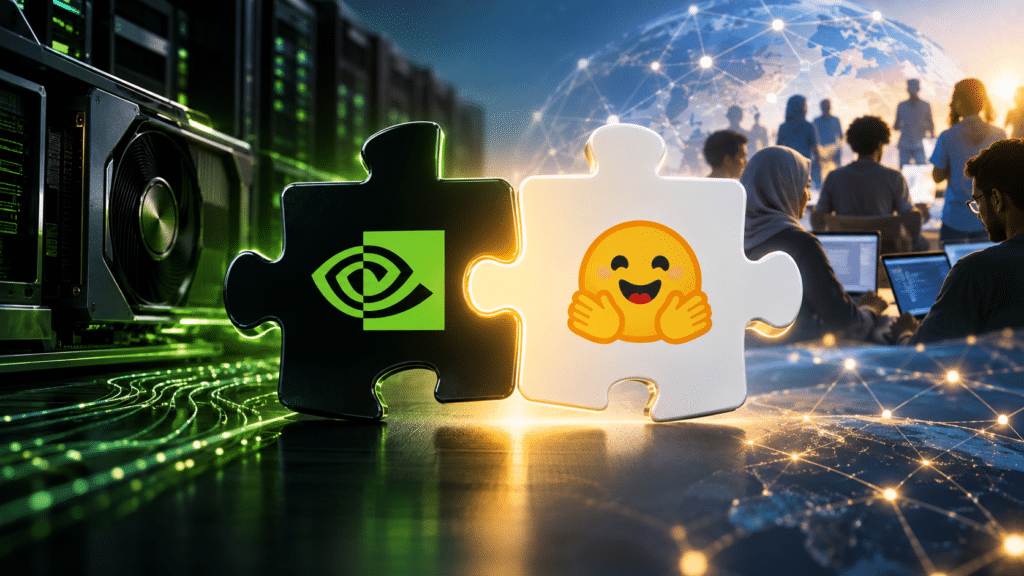
Nvidia’s acquisition of Hugging Face is one of those developments.
On September 3, Nvidia confirmed that it was acquiring Hugging Face, the platform widely used to host and share open-source AI models, for close to $13 billion. While another chatbot launch may attract more immediate attention, this deal offers a much broader view of where the AI industry could be heading.
The significance of the deal isn’t simply the size of the acquisition. It is about where Nvidia is positioning itself within the AI technology stack.
What Is Hugging Face?
Hugging Face has become an important part of the open-source AI ecosystem.
The platform allows developers and researchers to discover, share, download, and work with AI models and related tools. In other words, while companies such as Nvidia are deeply involved in providing the computing infrastructure required to train and run AI, Hugging Face plays an important role in making many of the resulting models accessible to the developer community.
That makes the relationship between the two companies particularly interesting.
Nvidia operates heavily at the hardware and computing layer, while Hugging Face operates at an important model and developer-platform layer.
Why Nvidia’s Hugging Face Acquisition Is Different
Traditional technology acquisitions often involve a company buying another business to gain a specific product, technology, customer base, or talent pool.
This acquisition represents something broader.
Nvidia’s chips already power a significant portion of AI training and deployment. Hugging Face, meanwhile, provides a major platform through which open-source AI models are distributed and accessed by developers.
Put those two pieces together and Nvidia becomes involved in two different stages of the AI pipeline:
Computing infrastructure → AI models → Developer distribution and usage
This is what makes the acquisition particularly significant.
Instead of looking only at the competition between individual AI models, it encourages us to look at the infrastructure underneath the AI ecosystem.
Nvidia Says Hugging Face Will Remain Open
One important detail is Nvidia’s stated intention to keep Hugging Face open and usable across different cloud providers and hardware platforms rather than restricting it to Nvidia’s own technology.
That commitment matters because Hugging Face’s value comes partly from its position within a broad open-source ecosystem.
Keeping the platform accessible to developers regardless of their preferred cloud or hardware environment would allow it to continue serving its existing role in the wider AI community.
At the same time, the acquisition demonstrates something worth watching: infrastructure used across an entire industry can change ownership as the industry develops.
That doesn’t automatically make the development positive or negative.
It simply makes ownership and control of AI infrastructure an increasingly important part of the conversation.
The Bigger Trend: AI Is Moving Beyond Models
If you follow AI news primarily through new model releases, it is easy to see the industry as a competition between chatbots and foundation models.
But a larger shift is taking place underneath that competition.
1. Hardware Companies Are Expanding Into Software
Companies that originally became important because of computing hardware are increasingly moving into software, platforms, developer tools, and other parts of the AI ecosystem.
Nvidia’s interest in Hugging Face is an example of this broader movement.
The AI value chain is becoming increasingly interconnected.
Hardware enables computation. Software makes that computation useful. Models provide intelligence. Developer platforms make those models accessible and usable.
The boundaries between these layers are becoming less distinct.
2. AI Infrastructure Is Becoming Strategically Important
The public conversation often focuses on questions such as:
- Which AI model is most capable?
- Which chatbot has the best features?
- Which company released the latest model?
- Which benchmark score is highest?
But another question deserves equal attention:
Who owns the infrastructure that developers and businesses depend on?
Model hubs, developer platforms, cloud infrastructure, computing systems, and AI development tools can become strategically important as adoption grows.
The uploaded source identifies this as part of a broader trend toward important AI tools and infrastructure being owned by a smaller number of large companies.
3. AI Consolidation May Happen Quietly
AI consolidation doesn’t always arrive as a dramatic announcement.
It can happen gradually through acquisitions, investments, partnerships, platform integrations, and infrastructure expansion.
While public attention remains focused on chatbot competition, ownership of the underlying technology stack can quietly change.
That is why major acquisitions can sometimes tell us more about the future structure of the industry than another model benchmark.
Does AI Infrastructure Consolidation Have Benefits?
Consolidation is not inherently good or bad.
Large companies acquiring important technology platforms can potentially bring additional investment, engineering resources, reliability, and faster development.
The source also notes these potential benefits while emphasizing that infrastructure consolidation is a broader phenomenon seen across rapidly growing industries.
The important question is therefore not simply whether consolidation is happening.
It is how that consolidation affects developers, businesses, researchers, and the broader AI ecosystem.
For users building on open-source AI, platform accessibility and interoperability can become particularly important.
What This Means for Developers
For developers using open-source AI tools, acquisitions such as this deserve attention because platforms can influence how easily models, tools, datasets, and development resources can be discovered and used.
The acquisition does not necessarily mean that developers will immediately experience major changes.
Instead, its importance may become clearer over time as Nvidia and Hugging Face determine how their respective ecosystems interact.
Developers should therefore pay attention not only to new models but also to:
- Changes in platform policies
- Developer accessibility
- Hardware and cloud compatibility
- Open-source commitments
- Model availability
- Developer tooling
- AI infrastructure partnerships
These factors can influence the practical experience of building AI applications just as much as model performance.
What This Means for Businesses
Businesses adopting AI should also look beyond individual chatbot products.
A company’s AI strategy increasingly depends on the infrastructure underneath its applications.
That includes:
Models — What AI models are available?
Compute — What infrastructure is required to run them?
Platforms — Where can developers access and manage models?
Tools — What software ecosystem supports development?
Portability — Can applications work across different infrastructure providers?
Long-term access — How dependent is the business on a particular platform?
The Nvidia-Hugging Face deal is a useful reminder that these questions can become strategically important as AI adoption grows.
Why Open-Source AI Matters in This Conversation
Hugging Face’s importance is closely connected to the growth of open-source AI.
Open-source models and tools allow developers, researchers, startups, and organizations to experiment with AI without relying exclusively on proprietary platforms.
This creates a broader ecosystem where models can be shared, adapted, tested, and integrated into different applications.
When a major infrastructure company acquires an important platform within that ecosystem, questions about openness, accessibility, interoperability, and long-term platform direction naturally become more important.
Nvidia’s stated intention to keep Hugging Face open is therefore a significant part of the story.
The AI Industry Is Bigger Than the Chatbot Race
The easiest way to understand today’s AI industry is often through products people can see and use.
Chatbots are visible.
AI models are visible.
New features are visible.
Infrastructure is much less visible.
But infrastructure determines what developers can build, which models they can access, what hardware they can use, and how AI applications are deployed.
That makes acquisitions involving infrastructure and developer platforms worth following closely.
The Nvidia-Hugging Face deal illustrates this shift particularly well: one company is deeply connected to the computing power behind AI, while the other is deeply connected to the ecosystem through which many AI models are shared and accessed.
What Should We Watch Next?
The acquisition raises several questions that will become clearer over time:
- How will Nvidia integrate Hugging Face with its broader AI ecosystem?
- How will Hugging Face maintain its open and multi-platform positioning?
- Will developers experience changes in access to models and tools?
- Will other major AI infrastructure companies pursue similar acquisitions?
- How concentrated will the AI infrastructure ecosystem become?
- Will hardware, software, models, and developer platforms increasingly converge?
These questions may ultimately tell us more about the next phase of AI than the release of any single chatbot.
The Bigger Picture
The Nvidia-Hugging Face acquisition is more than another large technology deal.
It highlights a fundamental change in how the AI industry is developing.
AI competition is no longer happening only at the model level. It is also happening across hardware, software, developer platforms, infrastructure, and distribution.
For developers, businesses, and anyone trying to understand the future of artificial intelligence, this means paying attention to the companies building and controlling the layers underneath the applications we see every day.
The chatbot headlines will continue.
New models will continue to launch.
Benchmarks will continue to change.
But acquisitions and infrastructure moves may provide a different — and potentially longer-term — perspective on where the industry is going.
The most important question may therefore no longer be simply:
“Which AI model is smartest?”
It may increasingly be:
“Who is building, operating, and owning the infrastructure that makes AI possible?”
That is the part of the AI story worth watching.
Key Takeaways
- Nvidia’s acquisition of Hugging Face connects two important layers of the AI ecosystem: computing infrastructure and model/developer distribution.
- Nvidia has stated that Hugging Face will remain open and usable across different cloud providers and hardware platforms.
- The deal reflects a broader movement of hardware companies into AI software and platforms.
- AI infrastructure and developer platforms are becoming increasingly strategic.
- Consolidation can bring benefits such as investment, reliability, and faster development, while also making ownership and platform direction important issues to monitor.
- Developers and businesses should watch infrastructure and platform developments alongside model releases and benchmarks.
Final thought: The next major AI story may not come from a new chatbot at all. It may come from the infrastructure underneath the chatbots.